Sunday, June 12, 2016

June 5 2016 Mud + Ranger=Uh oh

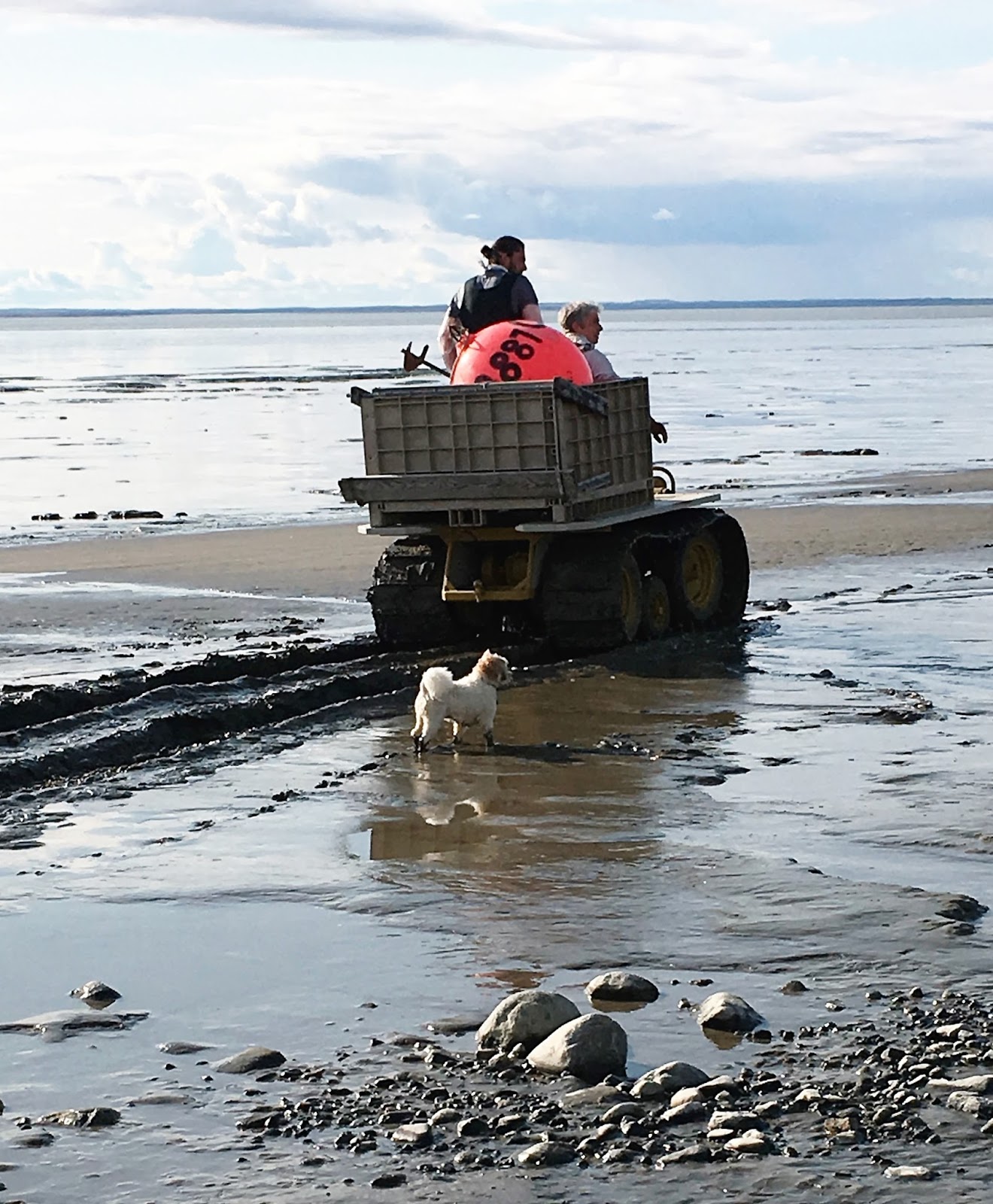
Oksanna and I started the day by driving the rangers from the turn-around to the sites. Oksanna was a quick learner and before long was puttering down the beach on the New Ranger, and I was following behind on the Friendly Ranger. Matt worked for Phil again today, learning a few knots in the process. Jean was changing the lives of everyone living, cooking, or eating in the crew cabin with her mad cleaning. Inku was better but still taking it a little easy.

I had gotten parts to fix the drain pipe from the sink in the crew cabin. I think it’s important to pour the waste water from washing over the cliff. There’s a pipe for that purpose from the cabin, but it had become seriously disconnected over the winter. I had wanted some repair to this pipe for a few years, as it just descended from sink exit height to the tundra and ultimately to the cliff. That was a problem for two reasons: (1) it kept coming apart and either no one noticed or if they did, they didn’t repair it so waste water kept spilling about 6’ from the cabin; and (2) it was about 6” off the ground when it crossed the walkway leading to the Space Hut, creating a tripping hazard and making it more likely that the pipe would come apart.

It's not just my fussiness that makes me want the water to go all the way over the cliff. Maybe it’s superstition instead, or maybe all that water in that one spot really will weaken the ground and hasten the sloughing of the tundra in front of the cabin. And maybe the smell of all that yummy waste water really will attract bears and other critters. I'm not sure I'm right to worry about all that, but still... just get it over the cliff, just in case.

So finally, after being bothered by it for years, I got the elbows and pipe from Ace Hardware to run the pipe down the outside of the house to then take a 90 degree turn and head over to the cliff. The problem was that I cut the pipe too long so that it took every inch of the space between the drain exit and the ground so that by the time it was all connected, the end of the pipe was a little higher than the bottom of the exit from the sink, meaning that the water will have to run uphill to empty out over the cliff. Still, that would probably be OK because the next water would just force the standing water along. Sort of like a J pipe. That is, until it froze. So I cut the vertical pipe, taking out about 3 inches and then joined it back together so that the end of the vertical exit pipe was higher than the cliff. Now we’ll find out how that works.

I had hoped we could get the buoys out today. Here are Matt and Oksanna coming over to get to work. While Jean and I were in town, Matt, Inku, and Oksanna refreshed the paint on the buoys (there are regulations governing how and where gear must be marked) and we worked together to pull them out of the cabin.


Here is Inku, pulling one of the early buoys over to the cliff. We decided to just toss them over straight out from Debby's cabin even though the temptation is to take them over to the stairs to where all things descend.

We had seven big red buoys, four of them with smaller white buoys attached, and five of them with 100' of wire rope also attached. It can be a tangled mess. Here is Oksanna organizing one and pulling it out to the cliff.

Again, Jean was our photographer. She got this great shot of the four of us pulling a series of the buoys to the edge of the cliff.


While I was pulling together the tools we'd need to put the buoys out (Crescent wrenches, wire, extra shackles, screw driver, PB Blaster, caribiners, and stainless steel rings) Matt, Inku, and Oksanna used a turning bar to get the anchor for the inside end of the inside site set more deeply.


Now, to the big experiment of the day: find out whether the Friendly Ranger – our most mud-worthy ranger – could make it through the mud that Jean and I had a hard time making it through on our second day.
First, we loaded up the ranger box with the outside buoys of the inside site, as well as the hardware we'd need to attach it all together.

And we're off, charging into the mud with great optimism.


Despite the optimism, we did realize that getting stuck was a possible outcome so we planned the test for early in the ebbing tide giving ourselves enough time to pull out a rope and tow the ranger back in with the truck if necessary. At first, the dogs were enthusiastically trailing alongside.

So, here we are, stuck. The mud defeated the ranger about 500’ from the beach.
Matt was part of this operation and we figured that since we were so close to the outside anchor for the inside site, we could just run the buoy we were carrying it the rest of the way out there on foot and at least get that finished. And that's what Matt did. He ran, literally. I can't explain how, but if you squint, you can see his high stepping legs frozen in motion. You might also be able to make out both dogs, leg-deep in the mud.

Then came the business of getting the ranger unstuck. Backward, forward, lean lots of weight over the front of the ranger so it will dig in, get a running start. The tracks were full of mud and just spinning. Finally, Matt jumped off and pushed as I ran it. We made a little progress. Then we both tried to clean the mud from the tracks and pushed again. A little more progress. Even though Matt said he wasn’t getting tired, I don’t know how that could be true. Inku finished what he was doing on the shore and came out to help. With the two of them pushing, we got out of the sticky stuff and were able to run the rest of the way in under our own steam.

Annie and Ollie were both up to their bellies in mud. Actually, Ollie went a little deeper than that. By the time we made it back in, Annie was worried and Ollie was whining and shivering. Jean tried to get them to stay in as we went out for the next step: putting out the running line. Here they are, cheering us on from the beach.
We have a garbage can that just about holds 700' of 1/2 line, piled in. The plan was to put the garbage can of line into the back of the ranger, tie the inside end to the inside screw anchor, and take off toward the buoy, where we'd tie off the outside end. That plan went fine... until we got to the impassable mud. This time I stopped about 10' before where I got stuck the first time out. From here, we just pulled the running line out by hand the last 250’ or so to the buoy to attach it. Dang! The big ring on the buoy was rusty and would likely abrade and eventually cut the running line. We carried a stainless ring with us, but forgot to bring it that last 250'. It looked like a long ways away. So I asked Matt to go back to the ranger’s tool box to get it. He ran! He said running helped him not get stuck. Yeah, the mud is tough. And I still needed their help to get turned around. Now that I’m thinking about it, maybe I could have just backed out.


And we returned, victorious, having gotten one site out, anyway. Ollie couldn't help himself and had to have just a little bit more mud.


There was a surprising amount of slack in the running line, so we tightened it up from the inside, and practiced knots in the process. I'm including this photo mainly because of the beautiful rainbow in the background.
Now we need to figure out how to fish this potentially heavy season without a very functional ranger. Uh oh.

Some of the ideas we’ve had are:
• Pull the nets early, so that we can deliver all our fish by water
• Carry a boat anchor and bring the capstan winch out and affix it to the ranger. That way, if we get stuck, we can run the boat anchor with a line on it toward our destination, wind the other end around the drum of the capstan winch and pull ourselves out of the mud, toward the anchor. But the mud would probably mean the end of the winch.
• How about an electric truck winch? Probably the same problem, and the process would probably eat the battery.
• How about taking the ranger part way out and pushing the bathtub part way in by hand. Or maybe getting an extra long line between the bathtub and the ranger (still on navigable land). Getting closer.

The prospect of getting the ranger stuck out there isn’t as scary as I would have thought because if Matt and Inku alone can push the ranger out of a spin, imagine what the rest of the crew all together could do. So anyway, I think we will be able to keep the ranger alive.

Matt, Inku, and I took the ranger to Monsen's Creek to wash it off. It's important to get the mud out of the brakes, but honestly, I don't really know how well we manage to do that, either running it up and down the creek or spraying it with our limited washdown spray once we get it set up. After returning with it, Jean and I took the truck to higher ground for the high tide that would come in the early morning. We saw this as we parked it.

Tuesday, June 7, 2016

June 4 2016: Oksanna makes three!

After yesterday's lesson with the tram, I doubled down on the decision not to try anything even a little risky to get the rangers down to the sites. That was about when Mark called about bringing down the one he worked on this winter (the New Ranger). I decided that we needed it on the beach as a back up to go out and rescue the other one if the tide was lapping at its stuck tracts. It would have to be a dire situation because just putting a ranger into that mud even once gives the mud a chance to work its dark magic on the go-around bits in the wheels of the ranger, creating corrosion havoc. It's a difficult (and expensive) job to vanquish that dark magic, so we try not to incur that expense for more than one machine per season.

When Mark called to let me know that he was bringing down the New Ranger, I asked him to make a second trip to bring down the Friendly Ranger as well. He gave me some important news about the New Ranger. If it runs out of gas, it is very hard to get started again. So hard that it requires some compressed air. A garden hose with a cloth on the end that you blow through will be enough to both get it started and to keep the gas out of the blower's mouth. My mental note went: Don't Run the New Ranger Out of Gas.

Oksanna's flight wasn't scheduled to come in until 6:20 PM. Inku was sick enough that he didn't go work for Phil for the day with Matt as he had planned. Matt learned to swab the deck and scrub the hull; Inku laid low and tried to get better. We pulled out the Tang to hasten that recovery process. Jean and I spent the day sorting out the crew cabin, putting away the 4 BIG BARRELS of food that critters or condensation might have ruined over the winter. I do hope we get through more of the canned food - and frozen food - than we did last year. We also made the first batch of survival bread, from the Cornell University recipe, reputed to be a complete protein. This activity, of course, requires the production of survival cinnamon rolls. Mmmmm.

Here is how Jean got kind of a raw deal. I do know about her that if something is dirty or disorderly, she just can't help herself. She has to fix it. When she has come up in the past, it's been at the end of the season. Our primary interaction with the crew cabin has been to get the food off the shelves, turning over any empty containers (not wanting to find a colony of dead lemmings in them the next spring), emptying out any water (not wanting to find any floating drowned lemmings), and adding rice to containers of canned goods to prevent rusting due to condensation over the winter. She hasn't had to think about people eating off plates that are resting on those shelves. She did have to think about that in my cabin... and she did something about it. But over there, why change the paper and clean the shelves so the mice and lemmings would have a nice, clean surface to dirty? (Probably assuming that we would do that ourselves in the spring. Ahem.) It's a different story at the beginning of the season. She put a few things away on the shelves... and then she saw their condition. Then she looked over at the shelves to the left. You could almost see the horror building in her mind. And so the cleaning fury started, and continued for a couple of days.

She tore herself away at about 4 pm so we would have time to take the four-wheeler to the truck at the top of the Beach Access Road (keeping it safe from the tide), get to AGS, and get the Friendly Ranger started and into an obvious location for Mark to pick up and bring down to the end of the Beach Access Road. We would then borrow Phil's car and go collect Oksanna. Starting the ranger wasn't as easy as I'd hoped. And we had it running just the other day! Grind, grind, grind... nothing. Grind, grind, grind... nothing. Finally, we gave up with a plan to ask Mark to come and figure out what was wrong and then bring it down. As we walked away, Jean commented that the light was on. The light was on? The light shouldn't be on. There are two separate switches: one for the light, one for the ignition. Could it be? Did I do that? Let's check. Oh. Yeah. Ranger starts! Yay! Sigh.

The sky was so beautiful and dramatic as we drove to King Salmon, though we did wonder how that translated into the quality of Oksanna's flight.
I don't think I've been giving credit, but I want to make it clear that Jean has been the photographer for most if not all of the photos so far this year. This one is on the way to King Salmon as we are passing the city dock. It was beautiful, clear, and sunny behind us; dark and ominous in front. The colorful container vans stacked up on the left side of the road were vibrant with the sun striking them on one side, set against the dark clouds behind them. To the right is the dock itself which unloads the big container ships that make it up the Naknek river after spring break-up. (Though this year, they didn't have to wait for break-up because the river didn't freeze.)

This shot is just a little beyond the city dock, as we're approaching Leader Creek, where Silver Bay and Phil's car live. To the left is the Shire, a sandwich shop with very limited hours and delicious sub sandwiches. Jean and I both loved the way the sun reflected off the wires running across the road, again, set off against the dark sky behind.
Something must be going around that got both Inku and Phil. He felt so sick he just left the keys in his fun-mobile to make the swap easy without having to get out of bed. But we were running late anyway. Luckily, Oksanna's flight was even later so we were there to meet her when she arrived. And we still had a chance to be tourists in King Salmon.

Oksanna arrived with her luggage. There are now three new crew members! We bundled into the Tercel and headed back to Phil's to swap for ol' Red. When we were at AGS prior to the trip to King Salmon, dinner had just started. I was a little self-conscious making the loud ranger noises during dinner. It took me several years to understand the meaning of lunch and dinner for the people who work at the processing plants. They work 7 days a week from 8 am to 9 pm from the end of April to the end of July. That's a long pull. How do they manage? That's where lunch and dinner come in: they get one hour for each meal. They spend the first 5 minutes inhaling their meal and then go lie down and power nap for 20 to 30 minutes. Then they take up their position for another few hours before getting another break. Those power naps are very important for their well-being and the reason everything stops at meal time and the reason it's rude to make much noise during those hours. We had brought the tram into AGS to see if Roy and his crew could repair it. Roy was in Egegik dealing with a propane emergency, but Jerry, Joe, and Landon were there. They were willing to try. They were very kind about it, which was a good thing because I was still pretty bruised about such a potentially disastrous event.

One of the things we shipped up on the March barge (which, by the way, was one of the ships to offload at the city dock in the earlier photos) was a new tire and two new rims for the Suzuki Carry. One of the old rims was ruined last year, putting the Carry out of business for the season. I dropped the tires and rims off at Roy's shop and they quickly assembled them. So at the same time we dropped off the tram, we picked up the ready tires. We decided to stop by at the Carry to see if we could get the new tire on, but we couldn't find a jack. Walk down to the shop and borrow a jack? Or drive the Carry down to do it there. Sold! But... the battery was dead. Aha! I have a portable battery in the net locker. Remember when I suspected that we did have power in the net locker because I could see a green light? It was on that portable battery. Hauled it over and ta daaa, the Carry started up. Jean stayed with the dogs in the truck while Oksanna and I took the Carry down to get the tire changed. The jack was the easy part. Landon tried to mount the new tire and although the bolt pattern was right, the holes for the bolts to go through were too small. So he and Joe set to making those holes larger, first drilling a piece of scrap aluminum to be sure that the resulting hole would work. Smart idea. They got it to fit... and they also worked on the new spare so if we did need it, we would be able to use it.

Through the whole extended process of getting the Carry into service, Jean kept the dogs in the truck. It had started to rain... well, pour... and Oksanna began to worry about her backpack in the back of the truck. So she joined the group in ol' Red. While waiting, Jean snapped these photos of the patient dogs.
I think they are getting quite a workout here. When they aren't running around, climbing the cliffs, or begging for food, they sleep.

While the dogs slept and Jean and Oksanna waited, I took advantage of Landon's expertise as an autobody guy to ask about the tailgate. He and Joe came up to look at it and without any hesitation pronounced "Toast."
Then he started thinking about it a bit more and wondered if he might be able to take that big dent out of it by running over it with a truck. Yeah, my tailgate - the best part of ol' Red's body - was so bad the only way to improve it that we could think of was to run over it with a truck. Sigh.

Oksanna drove ol' Red down the Beach Access Road and I followed in the fully functioning Carry! After parking the Carry, we all piled into ol' Red for the final leg of the journey to the cabin. After settling Oksanna in, Jean and I, joined by the dogs, took ol' Red back to the turn around at the end of the Beach Access Road to keep it safe from the increasingly high tides. Ollie is an adventurer.
I kind of think his self-image is part wolf/ part dolphin/ part Greyhound. When he is near the water, he can't seem to resist wandering in and swimming around. It's a little scary sometimes. I even heard myself warn him, "Don't make me come in and get you..." Jean and I were on the four-wheeler on the way back. We didn't drive fast and the dogs were keeping up. But Ollie kept running in front of us until we finally got the hint. We stopped and Jean scooped him up, holding him between us. She said that he didn't move a muscle.
He was cold, tired, and shivering by the time we got home. Time for bed!

Monday, June 6, 2016

June 3 2016: Inku arrived... and no one got hurt!

We've started thinking about how to get the Friendly Ranger down to the beach. For the past few years we've been moving them around on the back of the boom truck but (and I hate to admit this) I don't know how to use the boom! David always does it and I think Jeff also knows how to use it. Maybe Sarah does too. But I haven't ever taken up the challenge of learning to use it. And it seems that the precious and maybe irreplacable Friendly Ranger isn't the place to start. I could drive it through town, but that's hard on the roads and maybe hard on the ranger, and in places, probably also hard on the driver. Maybe our friends at AGS could take it down for us? No, they're not quite ready to start their beach trips yet.
Eddie offered to let us use his tilt-trailer. We went to his place and checked it out. And I saw his house through a new crew member's eyes. Pretty cool, huh? He is a hunter, among many other pursuits... now, including parenthood!!
I don't know this, but I'm guessing that this is part of a moose that he hunted. He probably shared most of it out.
People used to store their sleds on their roof. Really, I don't know why, though I know why I would do it. Two reasons: 1) to avoid tripping over it in the non-snowy months; and 2) to be able to find it in the snowy months. The tradition continued with snow machines for many people... but I don't know how they get them up there.

Once we finished gawking at Eddie's window boxes, birdfeeders and pile o' antlers, we got back to business and checked out his trailer. He told us we'd need a 1 7/8" ball hitch for the truck and it seemed pretty sure the one we had was bigger. I thought we could do that. The weather forecast said it probably wouldn't rain (much) today, so we thought this might be a good day to (a) try out the trailer and (b) haul down the beach (and up the cliff) some of our stuff we sent on the barge in late March. The priority was (b) because we didn't want to be have all our stuff soaked in tomorrow's rain. So while I went to King Salmon to get Inku, Jean and Matt stayed at AGS to get two of the totes loaded into the back of ol' Red and to get the new ball to use with Eddie's trailer.

Not only did I get to take Phil's little fun-mobile up to King Salmon again, I got to take Phil with me. (Ok, so maybe he was looking for an excuse to stop working for a minute.) Inku arrived... with all his luggage. Our check for Matt's luggage came up empty, so it would probably make it on the next flight. I wonder if the luggage that has already become separated from the passenger has a lower priority than the luggage that is still with the passenger. I think that's what I would do if I were in charge of luggage. The first luggage-less person has already adapted and already forgiven the airline or vowed never to use it again. And that person has already stood in line to fill out the necessary paperwork and that paperwork has already burdened the system. So I think I would avoid all that for a new person and just stretch the original person's patience a little bit more.

We returned to AGS, got the totes loaded, and on the way down the beach, I thought about using that tilt trailer to get the rangers. I tried to imagine how it would work. Maybe I didn't look closely enough at the trailer, but it looks like the bed and the tongue tilt down so the ranger can climb on until it goes over the tipping point, and then it tips the other way. I'd have to hope that the truck would be right in the right place to catch the hitch. Naah... that can't be right. But I finally decided to ask Mark up at Pen Auto to take it down to the turn around along with the one he worked on this winter. It took a few days to get to that decision - the third of June being one of the most significant of those days, leading to this relatively conservative decision. More on that later.

On the way down the beach with the totes, we stopped by Eddie's second hangar to pick up the blue four-wheeler. I had tried to start it earlier, with a lot of grinding and not much starting.
The same thing happened this time. However, this time I did something different: just in case it was lower on gas than I thought, I turned the control to "reserve"... and it started right up. OK, back to the gas station and on to the beach, this time with Inku on the blue four-wheeler and Matt on the green one. Here they are going down the tundra road (Beach Access Road).
Here is Inku, after his first ride down the beach on a four-wheeler.

We put the tram into service to pull up the groceries and other items we bought in March and shipped on the barge. It's a platform about 3' square that my brother in law designed to ride up and down the stair stringers. The wheels fit perfectly over the angle iron he welded to the stairs and we use a capstan winch at the top to pull it up. Jeff is usually the operator so it was a stretch for us to get it going and feel confident about it. The winch is set back on the tundra about 50' from the stairs (because that's where the screw anchor was). We attach a 1/2" line that doesn't stretch much to the front end of the tram, run it through a pulley at the top of the stairs, and back to the winch. We lowered the tram and tied the end of the line to the tight line that was holding the load, between the winch and the tram. Then we all went down to help load. We stacked about half a tote per load, then we all ran up the stairs for the pull. Matt stood at the top of the stairs to watch the ascent and signal to Inku. Inku started the winch engine and watched for Matt's signal with his finger hovering over the kill-switch waiting to stop it when he got the signal that the load was at the top of the stairs. I controlled the line and the rate that it came up the stairs. We had four wraps on the drum of the winch, so it was pretty secure. I had the time to run the line through the eye of the anchor and tie it off, then we all went to help unload.

We emptied the truck that way, packed the boxes and crates into the crew cabin where Jean was working on putting everything away. We went back into town for the other two totes. We brought up one load; it went fine. Then we brought up the second load. This time, I thought instead of taking the time to run the line through the eye of the screw anchor, I would try to just tie it off on the taut line, like I did when the tram was at the bottom of the stairs for loading. After all, at the beginning of the pull, it was a pretty mellow process to get the winch started, untie the clove hitch holding the fully loaded tram in place at the bottom of the stairs, and start the pull. I thought the tension would be about the same, thinking that the four wraps of the line on the drum took most of the excitement out of it. After I tied it off, I started toward the tram to help with the unloading, but noticed that the knot was beginning to slip. So I thought I needed to go back to the way I had been tying it, through the eye of the screw anchor. I started to untie it, thinking it was pretty secure with the four wraps and was surprised (to say the least) when the whole thing ripped out of my hands and the tram started to careen down the stairs. Bang! The tram, filled with many pounds of cheese and vinegar and waders, slammed into the tailgate of the truck, the only part of the truckbed that worked. It damaged the leg of the tram, putting the
wheel out of alignment and tearing a weld. The tailgate took such a dent that it is now a inch from latching on either side. Or maybe a little more. The beach was covered in cheese and vinegar and surprisingly, nothing broke. Well, none of the groceries broke. I guess the tram and the trailer took it all. Here we are examining the damage. See the wheel that isn't exactly straight any more? Inku proved himself to be a true setnetter. His strategy was to wale on that aluminum strut until it straightens out.

Matt and Inku brought most of the rest of the stuff up the hill while I help a neighbor get their four-wheeler un-stuck. Another person stopped to help and said he had gotten stuck just the other day. The beach is s-o-f-t. Once they were on their way, I went to work delivering to the crew cabin the supplies Matt and Inku were bringing up the stairs, and Jean put it away. It was a grueling evening's work and I could not shake off such a frightening mistake that could have had terrible consequences... and didn't.

The next morning, Matt went off to spend the day working with Phil. Inku had also planned to go, but he woke up feeling pretty sick - sore throat. He is feeling better now.

Sunday, June 5, 2016

June 2 2016: Matt day

Such a good day! It even rained a little bit. And the weather says it will rain more soon. My water barrel needs it.

We meant to get into town ahead of the tide today, but... well, that didn't happen. So we waited until after the tide and went then. Matt's flight was due to arrive at 6:20 PM. So we headed in around 2:30 to try to get the Friendly Ranger running - the one with the widest possible tracks and therefore the greatest possible hope of surfing the mud. After a little bit of fiddling and a belch of black smoke, it ran!! That felt like success.

We've had this ranger since 1980. It was our second ranger. We bought our first ranger in 1979 and we really needed it. We didn't use skiffs yet and that was a year with many many fish. I'm not sure how it compares with our heavy years now because we didn't really keep track of our poundage back then. Now with the skiffs, we are out on the nets, taking out the salmon and delivering them as the tide comes in and we keep it up the whole tide. Sometimes, if it's slow, we'll come in and have a cup of hot cocoa or take a short nap, but if there are fish, we're out there with them.

In 1979, we were still a few years away from our first skiff, so we could only watch as the nets filled up through the flood. As soon as the tide dropped enough for us to reach them on foot in our waders, we were on them - dressed in chest waders, rain coats, and cotton gloves with a 6' fiberglass dingy tied around our waists - picking fish furiously, trying to keep up with the tide. Every fish we picked in the water and then floated in to the drivable beach in the 6' fiberglass dingies tied around our waists, was a fish we didn't have to pick in the mud and then drag through the mud to deliver. Those little boats would hold about 100 fish - 500# - and keep floating. Our first goal was to keep up with the tide, but our most important goal was to avoid picking fish in the mud.

It takes about 3 times as long to pick the same fish after it's been sitting in the mud than when it was in the water. And that's not even counting what it takes to get them in to the beach so they can be delivered. It became a lot harder to beat the tide when we started fishing the outside sites. Even with the brand new ranger that worked hard to tow the dingies back to shore for delivery, in 1979 we still had too many fish out there on the mud flats to get them into the beach before the tide came back in to claim and scatter them.

When we realized that we were about to lose a lot of that tide's catch, desperation drove us to an innovation: we used about 10' long lengths of coated wire - the stuff we usually use for clothesline material - and threaded it through the gills of one fish after another until we had about 50 or more all threaded together. Then we closed the loop and gave it to the tide. We didn't know how it would work out, but we did know that even with the ranger running full out from the time the water was off the flats, we couldn't get all the fish in. We were thrilled to look out after the next tide to see the piles of fish out there by our sites, just slightly shifted from where they had been. We were able to collect them and deliver.

Those were the days of the peughs. Peughs are sticks about as long as a broom handle with a sort of skewer on the end. When we filled up a boat, we'd pull it in to the part of the beach that the cannery trucks could reach and tip it over, dumping the fish out onto the sand. When the cannery trucks came by, the drivers would pull up to a pile; one driver would peugh the fish by the head one by one into the back of the truck while the other counted them on a hand counter. Back at the cannery, they would dump them all into a giant washing tank, and pull out 100 to weigh to create an average poundage, the basis of our pay.

Back to the rangers - we loved that first ranger. But its tracks were only 12" wide and it couldn't tow or carry much through the mud - even itself. And something about it makes it a little unstable. It steers by its two hand brakes. It has three forward gears and it is necessary to come to a complete stop before shifting gears. The throttle is set by hand. There is no emergency shut-off. We hadn't had it for long when Harry decided to use it to help him pull one of our buildings away from the edge of the cliff. He drove down the beach to a low spot in the cliff and then drove back across the tundra. But the tundra is lumpy and when he hit a hard lump he bounced most of the way out of the ranger, just hanging on by his foot and dangling in front of it. The ranger was oblivious to its driver's danger and just kept crawling along on whatever path he had last set it on, at the speed he had last set. It could have taken him over the cliff or into one of the tundra gaps. He kept his wits and defying gravity, worked his way back in. We learned something about center of gravity there. It is also the ranger that fell off the planks he propped up onto the back of the cannery truck to take it into town at the end of the season. It even tipped over on me once as I tried to run it up the cliff to park it out of the tide. (I jumped off.) We call that one the Killer Ranger. In 1980, we bought the wide-track ranger and found that it went through the mud better and was much more stable. That one is the Friendly Ranger. The one we use now, and will soon test for its ability to manage this record-setting mud, is the Friendly Ranger. That's the one we got started before heading up to collect Matt.

Because our white truck is in the shop and we are relying on ol' Red, we borrowed a spunky little Tercel from our dear friend Phil to go to the airport. We had a little extra time so we stopped in for a cup of water and a tour of the Fortress of the Goat, the housing of the Goatroper captain and crew. They have stacked two container vans, the bottom one dedicated to fishing gear and the top one decked out as a comfortable and cozy summer cottage, complete with propane stove and oven, running water, a small refrigerator, three bunks, and even room to set up folding chairs. Pictures to come.

Matt arrived without his luggage. This isn't so surprising this time of year because people coming in have the need for so much stuff - way beyond normal luggage expectations. The planes fly in stuffed with people and cargo, and go back fairly empty (that's called the "backhaul").

Matt was philosophical about not having his luggage. And he is ridiculous in his ability to describe it. When we finally saw it, it was clearly a burgundy and black duffel witha woven design that might have come from Guatemala. Here is a photo of it. What do you think? How did Matt describe it? "A black duffel bag." Good thing the baggage people don't pay much attention to what people say and just go by their numbers. We decided that it was time for him to learn to ride the four-wheeler. I rode behind him to get him through town. It's a difficult route to describe but important to know because four-wheelers, all unlicensed, are not allowed on the road.

Once on the beach, he dove right into the tasks we'd set out for him. He completed opening the crew cabin, removing the boards from all the windows and he got the composting toilet ready for use while Jean and I continued to sort out and open my cabin. That was enough for the first new guy's first day.

It was a beautiful day so we all went for a 10:30 pm walk, just ahead of the sunset, to look for agates and to visit Pedersen Point (PPT). Jean found the only three agates of the evening and we learned that PPT will be processing this season. I wonder about those rumors to the contrary?

Thursday, June 2, 2016

June 1 2016: Maps and photos

David and Sarah asked me to let people know that they've used technology magic to link this blog with their Naknek Seafood Facebook Page. I didn't even know they had a Naknek Seafood Facebook page. I just went to look at it and they've had it for a while. They thought that it might provide an easier way to leave a comment or ask a question. Here goes: I'm trying to include the link so if you want, you can just go there instead of having to look it up. https://www.facebook.com/search/top/?q=naknek%20seafood. Did it work? Maybe not - OK, copy and paste.

We started early today to beat the tide into town. I like to use the Capt'n Jack's tide book that shows the tide wave, but it doesn't start until June 1. Slackers! Tide was high at 11:23, a 22.1' tide (according to the Naknek book. I grew up thinking in terms of Nushagak tides and really, it's hard for me to make the switch even though we can now get Naknek tides. In Nushagak-speak, it was a 20' tide). We made it across Monsen Creek at about 10 am when the tide was at about 17'. It was a little tight getting around the concrete slabs protecting the ramp to the Beach Access road, but we made it with our precious duffel bag of dirty laundry.

Jean manfully processed that duty while I did some Seattle work. As soon as the laundry was done, he headed back down to the beach to keep our date with the mud flats (on the outgoing tide). Oh my. We decided that Jean should stay on the beach (in case she had to go get the Coast Guard to extract me from the mud). I tried a different route, heading out to site #4, the farthest north. This photo
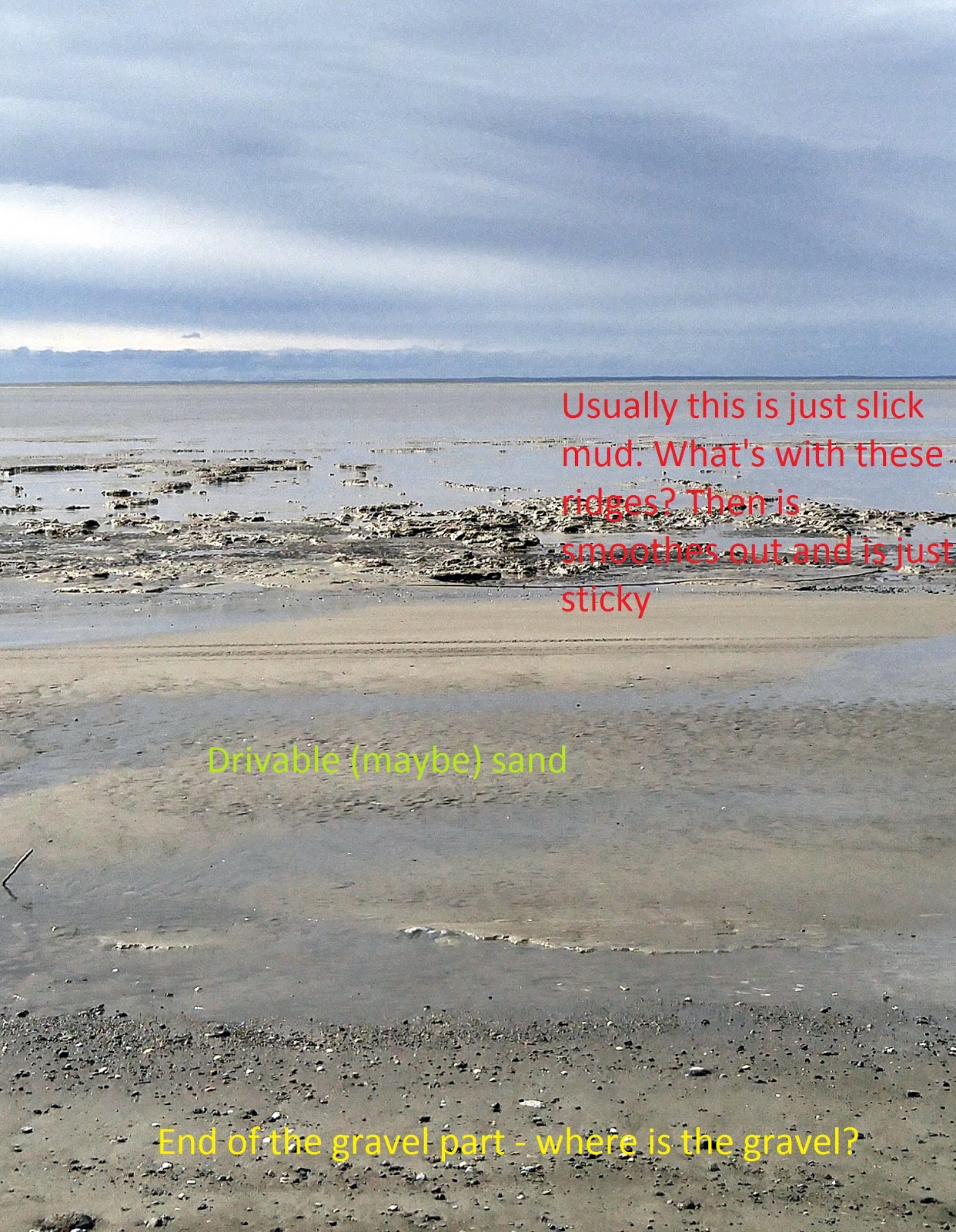
shows the strata on the beach. The wide swath of gravel and boulders make up most of the beach (though the gravel seems to be missing), then the hard sand (question on the "hard" there), then the new moon crater mud where there are 5" mud cliffs and the lower regions without much mud, then the thick stuff that will make any smokers among us suffer and improve everyone's cardiac health. Assuming we survive the process. If you squint, you might be able to see my staggering footsteps as I headed out to find out more about this year's mud and to look for our screw anchors. Great news: I found all the anchors, so we don't need to put any down to start fishing. Bad news: that calf-thick mud seems unavoidable and it extends from about 100' from the sand until half way into the 300' gap between the inside and outside sites. In the next few days, we'll take a trial run with the ranger - will those treads keep it from sinking? Will the grousers (the angle iron affixed to the treads to give traction) find traction on that mud? The first time the ranger goes out in the mud, it will be towing a line that we will be able to use to haul it back in, just in case it can't manage this mud. If that's the case, we will be in a whole different world.

Matt comes in tomorrow (June 2)! He will fly from NYC to Seattle, then from Seattle to Anchorage, from Anchorage to King Salmon.
This map shows where, in Alaska, Bristol Bay is located. I also pointed out Lake Iliamna on this map. This is where half of the world's red salmon comes from. Lake Iliamna is where the Northern Dynasty Mining Company hopes to dig Pebble Mine, in search of gold and copper. You'll be able to see the permeability of the ground in this area in the next few maps. The big concern about the proposed mine is that it is very likely that somewhere along the line, the protections will fail and if they do, because of the permeability of the ground, the poison would spread out all over the region, creating a disaster for this ancient run of salmon and the fishery that depends on it. Imagine a piece of bread in a bowl of milk. If you put some red food coloring in the bottom left corner of the bread, before too long, the top right corner will be tinged with red.

Let's take a closer look at our part of Bristol Bay.
Way over in the bottom right corner, you might see "King Salmon." That's the airport. 737s can land there, but usually much smaller planes serve the area. We'll pick Matt up in King Salmon in a friend's station wagon as my go-to-King-Salmon truck is in the shop, and follow the white road along the Naknek River back to Silver Bay, his processing plant, to swap vehicles. Millions of fish return to the Naknek River every year. Fish and Game are determined to make sure that at least 800,000 of them escape the fishing fleet and make it up the river and past the counting tower (where they literally count the fish). These fish aren't yet home free because they still have to make it past other predators (like bears, a lot of them).
But wait, here is a Google Earth map of Kvichak Bay and the end of the Kvichak River. Look at how big it is compared with the Naknek River. This is the dent at the top of the box on the Alaska map above. It's a big deal. This is the river that drains Lake Iliamna and the river that even more millions of salmon return to every year. (And the river that we got kind of lost on in our skiff a couple of years ago on our end-of-the-season adventure.) Fish and Game wants between 2.5 million and 10 million to escape into this river, and many more are harvested to feed a hungry world. Our homestead was on the shores of Lake Iliamna and I've heard people talk about how they used to fish with shovels because the fish were so thick in the streams.
Back to the route home: From Silver Bay, we'll go on into Naknek and probably just keep on going through town so we can get back down to the cabins before it gets too late, though we'll have light up to about midnight. However, we may not have a functioning Matt for that long. This map zooms in a bit. It shows how Naknek is on a point and how the (yellow) Beach Access Road cuts across the tundra and runs down onto the beach. (That's the first blue circle.) That ramp sometimes washes out in the high tides, but last year, they put big concrete slabs there, so we are optimistic. Before that road was built, we just drove along the beach the whole way. If you head north on the beach a little bit, you'll see another blue circle. That's Monsen Creek, one reason it can be hard to get to town on a high tide. It fills up and becomes wide and deep. When we got the truck stuck on our first trip down the beach, it was between the two blue circles.

Now we've taken the beach north about a mile from the beach access road ramp ... and we've arrived at the cabins!
Here is an aerial view, showing the cabins up on the bluff situated in the green tundra, and the nets fishing in front of the cabins. This shows only our nets. When we're fishing, we would see the Williams' four sites to the south of us, the McClain's site inside our #1, the Hakkenen's net outside our #2 and other neighbors north of #2 and inside #3 and #4. There are nets all along the beach. You can tell the tide is going out because the nets are belly-ing toward the Bering Sea. When the tide comes in, the water pushes the nets in the other direction.

At the top of the cliff (reached by climbing the stairs that Jean and I pulled down), Matt will probably notice first the crew cabin. When a friend of Alex's came up one season, the first thing he said was, "This is the ghetto-est place I've ever seen. Cool." I think of it as Baltic Ave in Monopoly.


Here is the crew cabin from the side in a shot that also shows the Space Hut and the bunkhouse/warehouse. Both are still boarded up and as the crew arrives, they will open the cabins and I hope, take careful note of what it means to prepare the cabins for the winter. These buildings also show up in the aerial view with the nets. My parents built the crew cabin in 1961. As the cliff has eroded, we've had to pull it back a couple of times. The warehouse was built at the same time, but it burned down in 2009, along with Harry's cabin, built in the early 80s. No one was hurt. The crew cabin is the hub of the camp. Lynnie built the Space Hut (though it wasn't the Space Hut until we reinforced it with flashing when we couldn't find any tin) and the bunkhouse a couple hundred feet off to the south.
My cabin is straight back or a little to the north, about the same distance from the cliff as Lynnie's. David's dad did a wonderful job building it in 1982 and I remain cozy in it to this day, (along with a small army of mice or lemmings).

The last cabin on the tour is Debby's. She and Darrell built it... in 1980? Quite a bit off to the north.
Debby had no sense of distance and did not intend to have a cabin about twice as big as everyone else's. But she ended up with a cabin that measured 20'X 30' (built on pallets in a swamp). The crew cabin was originally 20' X 24' and housed two adults and six kids. Lynnie's cabin was 16' X 20'. They later added an 8' x 20' mud room to the front of the cabin. Mine is a compact 12' X 20', with an added 8' X 12' mud room.

Wednesday, June 1, 2016

May 31 2016 Clean or dirty?

That is so much our question when we first get here. We meant to venture out into the mud again today. But somehow, cleaning the shelves of mouse droppings won our energy.

How could that be? There is the tide factor - we want to be sure that if we make the investment in gearing up, expending the energy, and using the duct tape to get ourselves out to the mud flats, we have plenty of time to look for the anchors. And it was so windy! It's hard enough to keep our balance with both feet trapped in calf-deep mud, but with the wind blowing against us at 25 mph? Why add that handicap? And then there were the dogs - were they ready for another mud adventure like the last time? They both still seemed a little traumatized. Plus, we spent the mid day collecting our friend Phil from the airport. The original plan was just to drop his car off up there, but I hear that whoever is in charge of towing, is towing vehicles that are left for too long. So we went to collect him in person which had the obvious benefit of being able to spend a little time with him. So, mouse shelves won out.

The cabin will be downright clean in a few days and I'll get to spend the season not trying to remember whether I can dry my face with this towel or if it is one we haven't washed yet.

We picked up stuff at the post office - crew onsies for the new crew, new wader boots, a pair of waders, and three of the four fishing permits!

We aren't sure what is wrong with the white truck. Mark said that they tried a bunch of tests and the 4 WD seems to be working. He wondered if I remembered to lock the hubs. It's tempting to be insulted, but really, that's a reasonable question and not an impossible mistake. But yes, I did. He did say that the ... wheel bearing? was out on one of the wheels and it was causing premature wear on one of the tires. So he will tear into it and fix what needs fixing. Still, glad it happened early.

Next up: laundry, completing some Seattle work, GETTING BACK INTO THE MUD!!!

May 30 2016: A day at the spa

We slept in. Jean made us breakfast today while I righted the water barrels and got the gutter back up so it would collect water – if it ever rains.

One of the important early tasks is to find the screw anchors. Those are metal poles about 1" in diameter and 5' long with an eye on one end and an 8" disk on the other, split to the middle and made into a spiral so that when we put a rod through the eye at the top and go around in a circle, the blade end will dig into the ground all the way up to the eye if we go around that long. We use the screw anchors to hold the buoys and nets in place. We really don't want an anchor to pull up during the season... nor do we want our lines to break or any other mishap that causes the net to swing sideways with the incoming or outgoing current, to get entangled with our neighbors' nets and generally make everyone's lives harder, most of all ours. When the net does that, it's called flagging. I hope I won't have the occasion to use that term again this season.

The regulations for setnet sites are that they must be fished reasonably perpendicular to the beach, the nets can't be longer than 300' (50 fathoms) and they have to be at least 300' apart. For years, setnet sites lined the Naknek beach from the mouth of the river (smoking hot sites) around the point down to Pedersen Point and beyond. When we moved from the homestead in Kokhanok to Naknek in 1959, Gunnar Bergen gave my parents the two sites that sit below our cabins. My mom said no one else wanted the sites because they were so muddy. That's us: mud people. In 1969, my mom and Jay Hammond (the man who would become Alaska's most popular governor) came up with the same brilliant innovation. They realized that no one ever said that the 300' had to be side to side. They could double their fishing capacity completely within the regulations by creating another setnet site 300' beyond the outside end of their traditional sites. It wasn't too long before other families did the same thing, though regulations were put in place to prevent that strategy in most other places. So as of 1969, we had four sites; two inside sites 300' apart and two outside sites, 300' away from the inside sites and also 300' apart. A second row of sites.

We fished as a family. In 1975, the Alaska government became worried about over-fishing. They didn't have a way to control how much fish the fishermen took because they couldn't control how many people were fishing. They felt that introducing a limited entry system would help them better protect the fishery by controlling the harvest effort. People were allowed to apply for permits. By then, many of my siblings had stopped fishing and my mom was very tied up in trying to change careers. So a few months from my 20th birthday, I got the application forms and filled them out for four permits for each of our four sites. They were awarded to me, Mom, and two of my sisters. To hold them, though, they had to be fished that year. Mom and my two sisters were not planning to fish, so they signed their permits over to Harry, Jean, and Jean's sister, Carol. I got a job to make enough money to get us and Harry's dog, Clydie to the fishing grounds (well, almost enough - and that is another story; a long one). We had a successful season-on-a-shoestring. It was just the four of us, without a truck or four-wheeler, without a ranger or a skiff, and without any money by the time we reached Naknek. I don't remember how many fish we ended up with, but the cannery paid us more than $13,000. I just looked that up and see that in today's dollars, our profits were about $60,000. Not bad for a bunch of kids.

When we returned to Seattle, Jean and Carol signed their permits back over to Mom and my younger sister who did want to return to fishing. But a strange thing happened. After Limited Entry came in, fishing operations began to be seen as individual possessions and not as the family farm. Some family members decided that they wanted to fish on their own, as individuals rather than as part of the family. That was heart-breaking to me because it felt like the thing that I knew as family was breaking apart. As some of the family members who held fishing permits that were associated with certain sites began to want to leave fishing, they sold the site and permit that was in their names to people outside the family. While that brought us lovely neighbors, it felt a little like the loss of a limb. Two of the original four sites left the family that way, but thanks to Debby, the sister just older than me, the last outside sites unclaimed on the Naknek beach that just happened to be next to our outside sites, came into the family. Eventually, when an injury forced her out of fishing, I bought those from her.

So now, instead of two inside sites and two outside sites in a neat square, our sites are all in a row on the beach and we name them that way. Starting with the first one on the left as we face the water, we call that one #1 (it's the site that was originally assigned to me, holding down the southwest corner of the original square), 300' north of "my" site is "Mom's site," or site #2. But this one is an inside site, unlike the other three. This one was originally Mom's, and it held down the northeast corner of the original square. Our neighbors now fish the sites that used to hold down the other two corners (southeast and northwest). Another 300' to the north of site #2 is site #3, an outside site and 300' north of that is site #4, also an outside site. #3 and #4 are the outside sites Debby claimed.

It is much much much easier to get the nets in the right place if we can just use last year's anchors. I mean, if they worked last year, they should work this year. So we strive mightily at the end of the season to mark the anchors to be able to find them at the beginning of the next season. They always bend over from the force of the current pulling on the net, especially when it is loaded with fish. So at the end of the season, we turn them back up so they are poking out of the ground, making it easier to spot them the next season. But that might not be enough. The channels shift over the course of a year, so they might be covered up by sand and mud. So maybe we should turn them up more? But then the icebergs might grab them and pull them out. We tie corks and lines and romex to the eyes of those anchors. If we can't find at least one anchor, we have to walk one way or the other until we find someone's anchor from last year. If we can figure out whose it is, we can pace back toward our nets to try to find where to put the new anchor down. We almost always have to move them again. So we are motivated to find last year's anchors. That was today's main task.

We watched the tide going out so we could start the search as early in the tide as possible. We hoped to find all 8 anchors, one for each end of 4 nets. The easiest one to find is the inside end of the inside site (#2). We straightened it out a bit at the end of last season so we found it easily. We tried to walk straight out from that first anchor. The next one is 600-700 feet from the first one, directly in front of Debby’s cabin. That is a hard one to find because the mud is so thick there, it often buries the anchor. We found it!! Those anchors are way farther apart than the anchors for our other sites because even though it is an inside site, we tend to fish it deep so it will fish longer. When the fish are up on the beach, we miss out, but overall, I think we do better with it deep.

That site is set up differently from the other sites. The outside sites have the two anchors (the inside and the outside anchors) about 300' apart to which 50' anchor lines are attached. Buoys are attached to those anchor lines and they just bob around out there unless we are fishing. When we are fishing, the 300' net is stretched between the buoys, perpendicular to the shore so that the fish will swim into them. The inside site is different because the distance between the inside anchor and the outside anchor is about 650', much longer than the net. So how do we reach between the buoys? We tie the outside buoy to a 650' line that runs all the way to the inside anchor. It's called a running line. It allows us to attach the net anywhere along that line. We could set that site up so that the net just fits between the buoys as we do the outside sites, but the running line serves another very important function. We can use to pull ourselves out to deeper water on stormy days.

The problem with stormy days (with a southwest or onshore wind) is that the wind creates heavy surf break. It is hard to push the skiffs out deep enough to keep the prop from grounding when a big wave picks up the bow and stands the skiff on its stern. Instead of risking the people and the equipment, we go to the running line, everyone hops in while the skiff is still in shallow water, and we all pull against the wind along the running line until the skiff is in deep enough water that we won't get thrown back up on the shore as we try to get off the running line, and we won't ground the prop if a big wave hits us.

The mud flats are different this year. The beach is organized in strips of material. Just below the cliff we usually find about 8’ of sand, clay and a few big rocks. And of course, everything that washes up. I don’t really understand why there was so much metal there this year – broken screw anchors, chains, the steering cable for an outboard, door of a wood stove… were these Sarah’s rejected candidates for garden art from last year? Then, where the beach starts to descend to the water right in front of our cabin for about 50' toward the water, we’ll usually find a band of gravel over a bed of sand and quite a few 1-man and 2-man rocks (those are hard on the skiffs’ props). We don't see the gravel this year; just the sand and big rocks. And only in front of our cabins. To either side we see many fewer rocks. Then the beach flattens out into a 20’ band of sand that is usually drivable. Then starts the bottomless, sticky, shiny mud that eats everything and goes on for about 700’. At least I hope that’s as far as it goes this year.

The sticky mud part is also different this year. I’m not sure how far it goes on because we stopped when we found the outside screw anchor of the inside site, and looking over to my site, we could see both the inside and outside anchors. (Though as I think about that, I wonder if we really saw the outside anchor because it’s been buried for at least 5 years.) Instead of 700 uninterrupted feet of shiny, thick, sticky mud, we found ridges of thick mud and wide swaths of where it seemed that the thick stuff had been swept away. That’s where we started the walk. Ollie and Annie came with us, Ollie in his new yellow life jacket (more for the purpose of discouraging eagles than to keep him safe in the water, since there wasn’t any at this time). As we counted our steps out to where we might find the outside anchor of the inside site, I wondered where the mud had gone. It was pretty easy going at first through the ridges. I got pretty excited about the possibility that the mud was astonishingly easy this year… until we got past the ridge-y part, probably about where the inside net would start. Once past the ridge-y mud, we found the spot where the missing mud had accumulated. And if we really did see both anchors from my site, it might also be where the mud that had been burying that outside anchor migrated to. It was amazingly worse than last year, which was the worst I’d ever seen. Thick – mid calf at least, and sticky! It grabbed our boots and did not want to let go. By the time we got back to the beach, we were both covered with it.
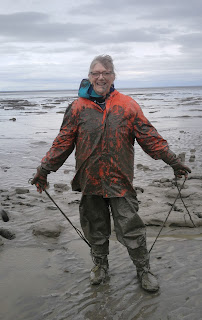
I was lucky because I was in my own gear and I’ve been practicing with pretty sticky mud for about 57 years. Jean, however, was in borrowed gear and hadn’t really been in the mud for 41 years. As it turns out, she seems to have a knack for finding the absolutely worst patches of mud. It was very tough going. To keep her boots on and to help her free her feet from that aggressively sticky mud, we tied some of the lines around her boots, with the tug-point at the back. It is unfathomably exhausting to pull yourself through mud while losing boots and getting increasingly discouraged. The dogs started to complain. One time when Jean was… let’s call it “lounging” on her back, Ollie rushed over, so relieved to find something relatively dry and solid to stand on, and hopped on. He didn’t get any hero points for that one. We considered just removing our waders and boots and taking the cold and foot-punishing route through the mud, but that seemed dangerous because of the cold, whereas we didn’t have any need to hurry and could just stay warm and dry through the increasingly slower haul back out of the mud. We made it!


The dogs were so thrilled to be back on the hard ground. If we had the energy, we'd have been frolicking like they were, too.
I asked Danita, who takes such good care of Ollie's coat to keep his back fur long, so he would look bigger to the eagles but to go ahead and cut his leg hair and belly hair short so he would be easier to clean. In a moment of inspiration, she shaved all around his butt, thinking that he might sit in the mud and this trim would also make him easier to wash. Well, it was a good idea...
We had accomplished much of our objective for the day: search out the screw anchors – we found 4 of the 8 we will need (check). The remaining 4 may still be visible, just not from where we were standing. We got some exercise (check) and a “baseline” measurement of our mud-fitness (groan, check). And we found out about this season’s mud (groan, check). Tomorrow we will go in search of the other four anchors, but this time, with our boots zipped (if possible) and duct-taped to keep them on. (Crew: everyone needs at least one roll of duct tape for the season.) And we’ll walk out at a different location – just in front of those outside sites, hoping it will be better. If possible, I hope that I won’t have to walk through mud like that again this season.
Not much chance of that. By the time we got back up the cliff, we were completely exhausted and Ollie was covered with mud, shivering and whining. Awww. So we trudged on back to the lake behind the cabin, washed our gear … and carried Ollie in to wash him off. It wasn’t quite enough, so I threw him back in. He was too tired to hold a grudge.

The rest of the day, we tried to recover and figure out what day it was, and what day tomorrow will be, what day is Memorial Day and how is that day related to today. And whether June 1 is a Tuesday and when our friend Phil is flying in. That was almost as hard as trying to get out of the mud. Trevor, one of Alex’s classmates who has found himself a home here in the fishery, once remarked that this place not only destroys your ability to know what day it is, it also destroys your ability to know what day comes next.